
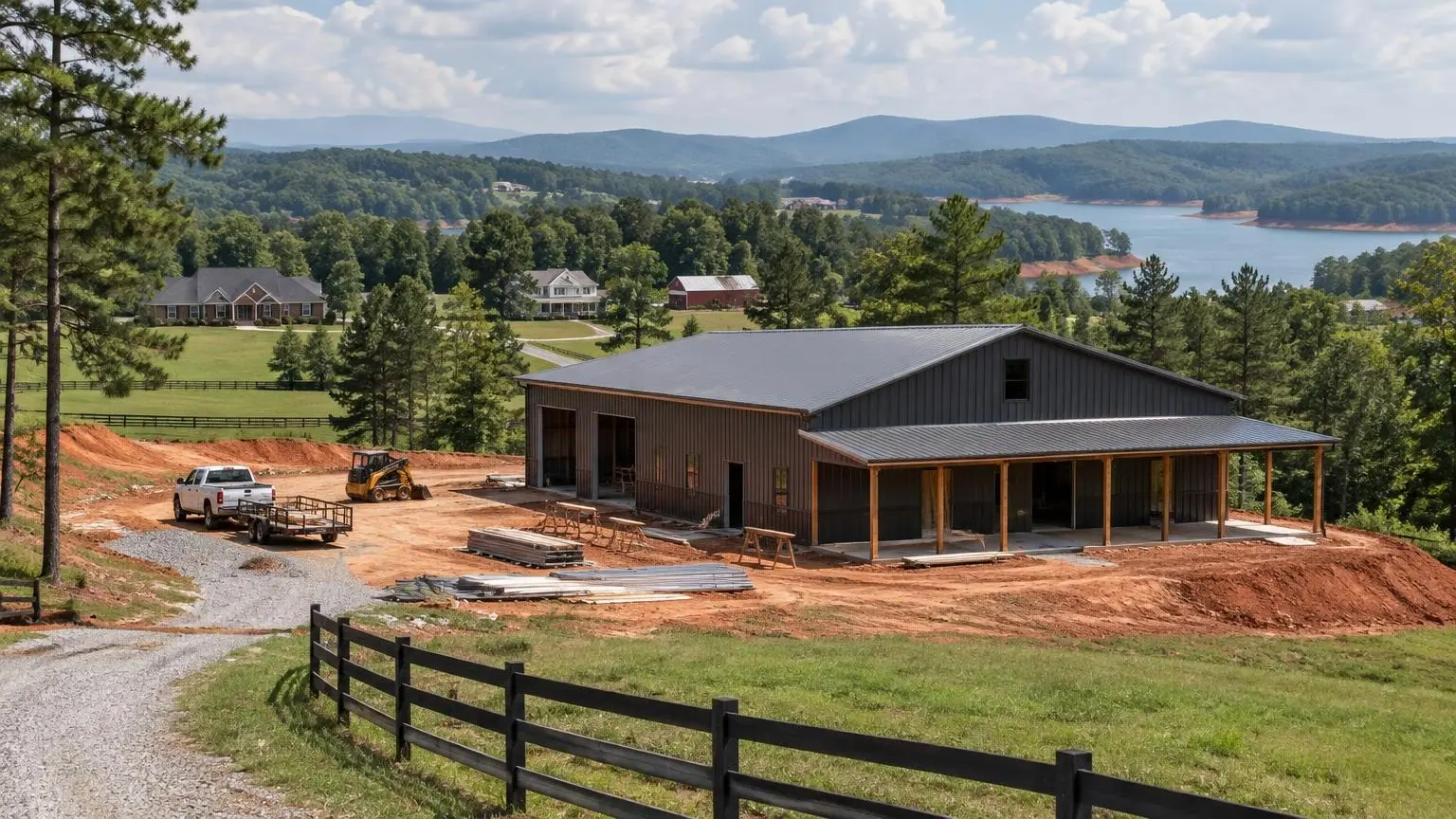
Hall County seat on Lake Lanier
Barndominium Builders in Gainesville, GA
Wooded foothill land, lake coves and a weather history that shapes how a steel home is tied down.
- Free on-site visit before pricing
- Written, line-item estimates
- County permit and septic research included
Start With the Weather, Then the Codes
Barndominium builders in Gainesville cannot ignore the city's weather history. On June 1, 1903, a deadly F4 tornado killed 98 people here, and in 1936 another tornado devastated the city and killed 203, ranked the fifth deadliest in U.S. history. Those events are generations old, but they are the right starting point for anyone putting a large steel or post-frame building in Hall County. A barndo has big walls, big doors and a broad roof, and every one of those has to be fastened to the foundation for the wind it may see.
What wind means for a barndo
The weak points in a metal or post-frame home are predictable: overhead doors, roof-to-wall connections, and the anchorage of columns or posts to the foundation. We size anchor bolts and embedment to the engineered design, specify wind-rated overhead doors, and do not substitute lighter hardware to save a week. If you want a safe room or a reinforced interior space, the plan is the time to add it.
The climate the rest of the year
Gainesville's 1991 to 2020 normals put the January mean high at 51.1 F and the mean low at 31.1 F, with July highs averaging 87.8 F and lows 67.8 F. Precipitation runs about 55.56 inches a year, and snowfall averages only 1.6 inches. In other words, snow load is rarely the controlling design factor, while rain and humidity are constant. A steel skin in this climate needs an insulation and vapor strategy that keeps warm, damp air off cold metal, and gutters and grading sized for heavy downpours.
Hall County's adopted codes
Hall County lists the codes it enforces, effective for permits issued on or after January 1, 2026:
- Building, mechanical and fuel gas: 2024 International Residential Code, Georgia-amended
- Plumbing: 2024 International Plumbing Code, Georgia-amended
- Energy: 2015 International Energy Conservation Code with Georgia supplements and amendments
The county also notes that submissions received before that date are reviewed under the previously adopted codes. For a barndo, the current set means the living quarters are reviewed exactly like any new house, and the shop side needs a proper separation from it.
Lake Lanier and the Chattahoochee
Lake Lanier was created when the Army Corps of Engineers dammed the Chattahoochee near Buford, and parts of Gainesville lie along its shore. About 60 percent of the lake is in Hall County. Lake-adjacent land can be steep and wooded, so a barndo there usually needs a careful cut-and-fill pad and a driveway that can handle concrete trucks. The western half of the county drains to the Upper Chattahoochee, while the eastern half, slightly more than half the county, drains to the Upper Oconee. That divide is worth knowing when you look at where a parcel's runoff will go.
Wells on rural Hall County land
The county's site includes a well permit page, filed under Environmental Health, with a permit application, well permit requirements and water well regulations. If your land is beyond public water, we place the well, the septic system and the building together on the site plan so setbacks work before anyone drills.
A rural county around a busy city
Gainesville grew from 33,804 residents in 2010 to 42,296 in 2020, and Hall County from 179,684 to 203,136. Even so, the county is described as extremely rural, with more than half of its residents living in unincorporated areas. For anyone planning a barndo, that matters. Outside the city there is acreage, and unincorporated land is reviewed by the county rather than the city, under the codes listed above.
Foothill terrain
Gainesville sits at about 1,214 feet, in the foothills of the Blue Ridge Mountains, and much of it is heavily wooded. Wooded lots mean clearing and stump removal, and they often hide a slope that only shows up once the trees are gone. We walk the site before final placement of the building.
Getting to and from Atlanta
Gainesville is about 54 miles from Atlanta via I-985 and U.S. 23, with U.S. 129 running 21 miles southeast to Jefferson and 24 miles north to Cleveland. Those corridors make material deliveries straightforward; the last stretch of rural road is what we check.
The Poultry Capital
Gainesville is nicknamed the Poultry Capital of the World, and in 2013 six of the top ten local employers were poultry companies. In a county with that working agricultural base, a barndo with a real shop and equipment bay fits right in.
From Mule Camp Springs to county seat
The area was first settled as Mule Camp Springs in the early 1800s. Hall County was organized on December 15, 1818, and the town was renamed Gainesville on April 21, 1821, for Edmund P. Gaines, a hero of the War of 1812. Its other nickname, the Queen City of the Mountains, fits the setting. Hall County covers 429 square miles, and about 37 of those are water, roughly 8.5 percent, mostly Lanier and its arms. In the 2020 census, 25.9 percent of county residents lived in rural areas.
Records worth designing for
The city's records run from 107 F on the hot end to -8 F on the cold end. A barndo shop bay that is not heated full time needs its water lines kept in conditioned space or protected, and the insulation has to keep interior surfaces above the dew point in both extremes.
Have land in Hall County? Call (678) 501-7569 or
and we will start with the wind design and the site.Hall County Facts for Gainesville Builds
- 2026 codes. Hall County enforces the 2024 IRC (Georgia-amended) and 2015 IECC with Georgia amendments for permits issued on or after January 1, 2026.
- Tornado history. An F4 tornado killed 98 people in Gainesville in 1903, and the 1936 tornado killed 203.
- Climate normals. About 55.56 inches of precipitation and 1.6 inches of snow a year; July highs average 87.8 F.
- Lake Lanier. About 60 percent of Lake Lanier lies in Hall County, and parts of Gainesville sit along its shore.
- Mostly rural. More than half of Hall County residents live in unincorporated areas.
- Well permits. Hall County publishes a well permit application and water well regulations under Environmental Health.
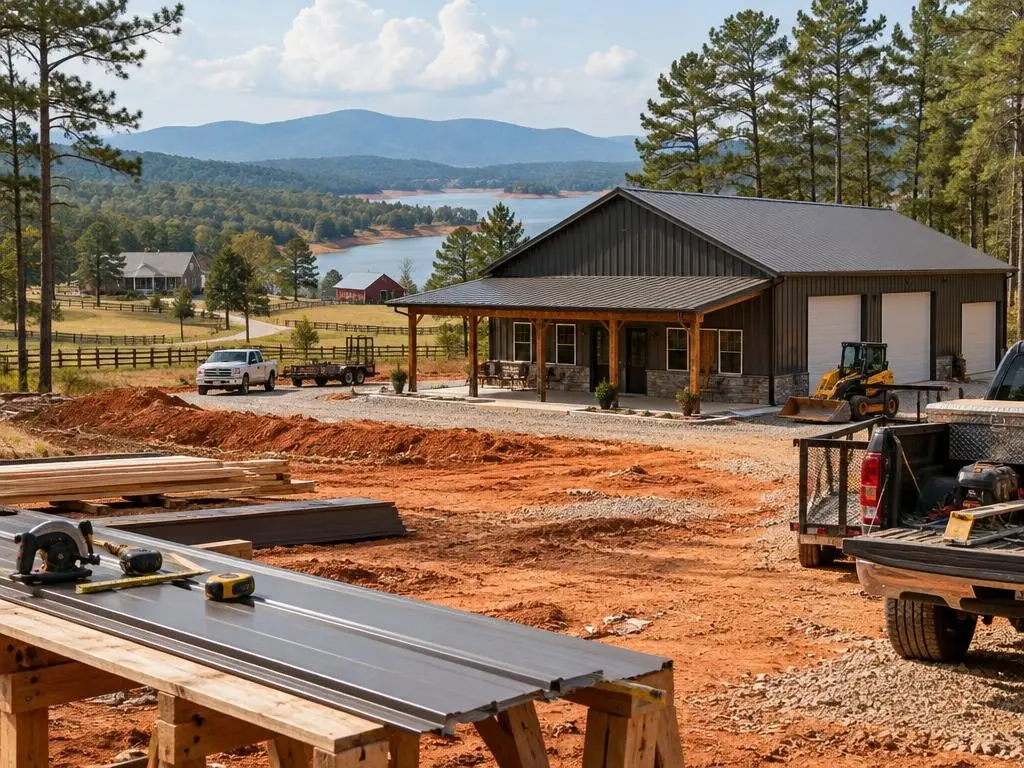
Our Services in Gainesville, GA
Gainesville Questions
Which code edition applies to a new barndo in Hall County?
For permits issued on or after January 1, 2026, Hall County lists the 2024 International Residential Code with Georgia amendments and the 2015 IECC with Georgia supplements.
How do you build a barndominium for tornado risk around Gainesville?
By following the engineered wind design closely: correct anchor bolts and embedment, wind-rated overhead doors and solid roof-to-wall connections. A reinforced interior room can be added in the plan.
Do I need a well permit for rural land in Hall County?
Hall County publishes a well permit application and regulations. We coordinate the well location with the septic and building on the site plan.
Is lake-area land near Gainesville harder to build on?
It is often steeper and more wooded. That means more grading and a stronger driveway, but it can work well with planning.
Free Estimates in Gainesville, GA
Build a Hall County barndominium designed for the wind and the weather.
Barndominium Builders Near Gainesville
- Barndominium Builders in Atlanta, GA
- Barndominium Builders in Canton, GA
- Barndominium Builders in Cartersville, GA
- Barndominium Builders in Dallas, GA
- Barndominium Builders in Douglasville, GA
- Barndominium Builders in Villa Rica, GA
- Barndominium Builders in Carrollton, GA
- Barndominium Builders in Newnan, GA
- Barndominium Builders in Senoia, GA
- Barndominium Builders in Peachtree City, GA
- Barndominium Builders in Fayetteville, GA
- Barndominium Builders in Griffin, GA
- Barndominium Builders in McDonough, GA
- Barndominium Builders in Locust Grove, GA
- Barndominium Builders in Covington, GA
- Barndominium Builders in Monroe, GA
- Barndominium Builders in Loganville, GA
- Barndominium Builders in Social Circle, GA
- Barndominium Builders in Winder, GA
- Barndominium Builders in Jefferson, GA
- Barndominium Builders in Cumming, GA
- Barndominium Builders in Dawsonville, GA
- Barndominium Builders in Ball Ground, GA
- Barndominium Builders in Jasper, GA
- Barndominium Builders in Buford, GA