
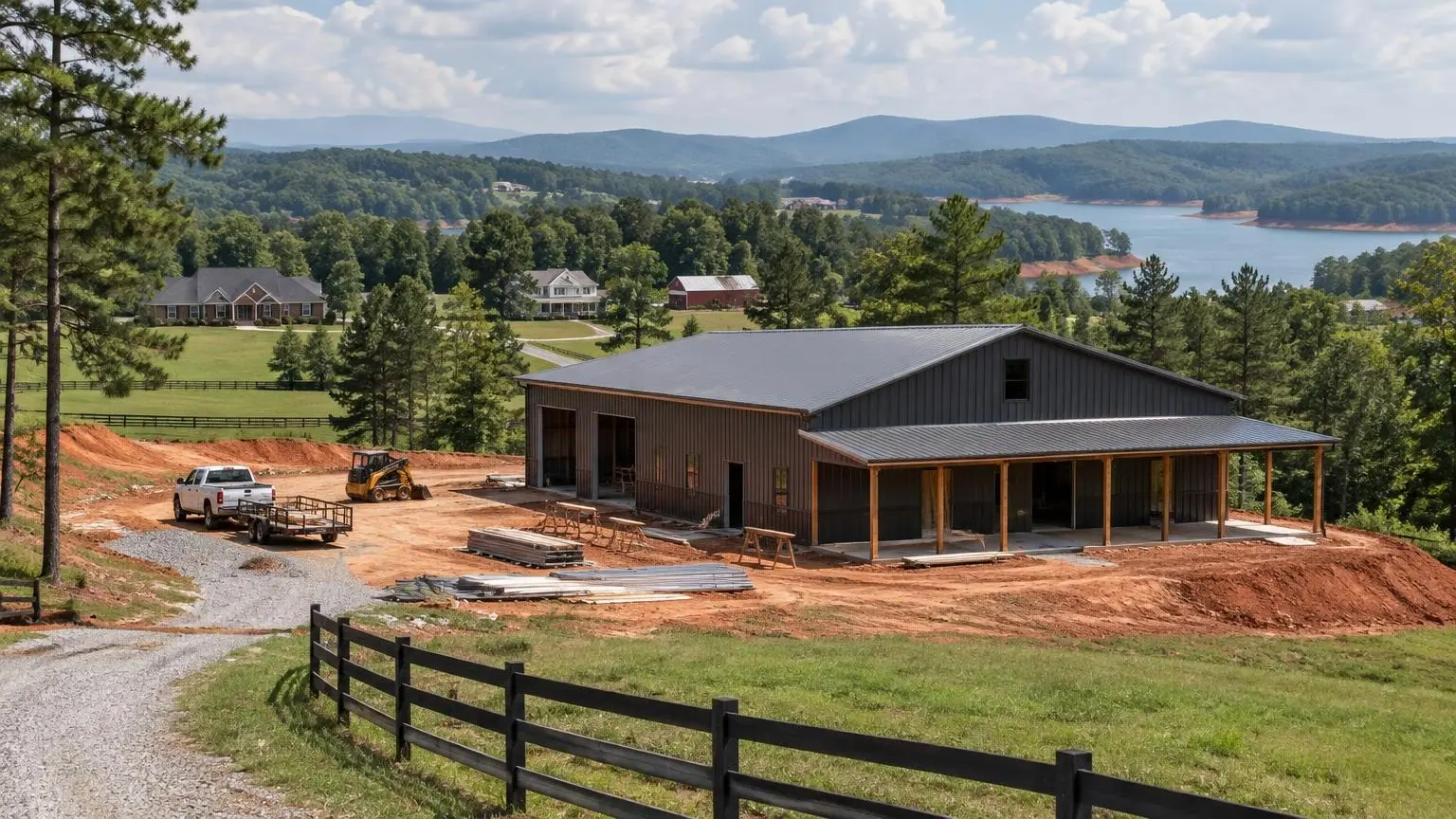
Old marble-mill town in north Cherokee County
Barndominium Builders in Ball Ground, GA
Hilltops and valleys over hard rock, an hour north of downtown Atlanta.
- Free on-site visit before pricing
- Written, line-item estimates
- County permit and septic research included
What Lies Under a Ball Ground Lot
Barndominium builders in Ball Ground should begin underground. Ball Ground sits in the Upper Piedmont physiographic province, in what geologists call the Hightower-Jasper Ridge District, on bedrock of igneous and metamorphic rock such as gneiss and schist. The area's mineral resources include marble, talc, pyrite and gold. For a barndo, that geology is a reminder that a foundation excavation here can meet rock, and that the soil report deserves a careful read before a slab or post layout is final.
Rock, slope and foundation choices
Elevations in town run from just over 1,000 feet in the valleys to about 1,200 feet on the hilltops. On a hilltop, the ground may be shallow to weathered rock; in a valley, it may be deeper soil with more water moving through it. That variation is why we do not pick a foundation system from a catalog. A monolithic slab suits a level, well-compacted pad. A post-frame barndo with embedded or bracketed posts can handle sloped ground with less cut. A stem wall can step down a hillside. The site decides.
City permit or county permit
Ball Ground is a small incorporated city in northeastern Cherokee County. Its Building Permitting and Inspections department issues building permits for residential and commercial construction within the city limits, and its Planning and Zoning department enforces the city's development code. Land outside the city falls to Cherokee County. For a new single-family home in the county, Cherokee County lists:
- a septic permit if applicable, applied for with the Office of Environmental Health before you apply with the county,
- proof of water and sewer service,
- an approved driveway permit unless the home is part of a larger development, and
- a house location plan, which can be a survey or plat of the property.
We sort out which office has your parcel before design begins.
Water and sewer service
Ball Ground's Water and Sewer Department serves about 1,300 households, both inside and outside the city limits. The city's water comes from a pumped well system, and the city handles its own sewage treatment, with a sewer system completed in fall 2003. If your land is near one of its lines, that may answer the proof-of-service question without a private well. Farther out, a well and septic system become part of the site plan, and the septic approval comes first.
Floodplains and stream buffers
The city is not in a floodplain, which is useful for in-town lots. Ball Ground still has stream buffer, watershed and wetland protection ordinances, so a creek crossing a parcel limits where the building and drain field can go. The Etowah River runs along the McGraw Ford Wildlife Management Area about 1.9 miles outside city limits; land near the river deserves a flood map check.
Climate notes for a metal home
Ball Ground has a humid subtropical climate. Using 1981 to 2010 data, July and August highs average about 85 F, January highs about 48 F and January lows about 29 F, with roughly 54.11 inches of precipitation a year. March is the wettest month at about 5.15 inches and May the driest at about 3.81. Spring rain is when a freshly graded pad is most likely to wash, so we time site work and stabilization with that in mind. The humid summers call for continuous insulation against the steel and an HVAC system sized to the real load.
Access and growth
Interstate 575 runs through the city with Exit 27 at Howell Bridge Road inside city limits, the last northbound exit before the interstate ends. State Route 5 and State Route 372 also run through town. Canton is about 4.7 miles southwest and downtown Atlanta about 48.7 miles away. Ball Ground grew from 1,433 residents in 2010 to 2,560 in 2020, so open land around town is being bought, and some of it is being platted into neighborhoods with covenants.
A railroad and marble town
The Marietta and North Georgia Railroad reached Ball Ground in 1882, and the depot became the center of the young town. The first marble company opened in 1898, and by the 1920s the city had four marble finishing mills. Marble and most other industry had declined or left by 1959. The town was incorporated in 1883, the year after the rail line was finished. A barndo, part workshop and part home, suits a town that grew up on rail lines and stone yards.
Erosion control is the first inspection
Outside city limits, Cherokee County tells new-home applicants that the first inspection is erosion control and that no work should start until it is in place. Inspections are scheduled online through the county's CityView portal. On a Ball Ground hillside, that means silt fence, a stone construction entrance and protection for any nearby stream are installed and inspected before the first load of fill moves.
A detached shop changes the paperwork
If the plan includes a separate shop building rather than a shop under the same roof, the county page notes that accessory structures of 2,000 square feet or more need professionally designed plans. A large detached equipment building can cross that line quickly, so we decide early whether the shop is attached to the barndo or stands on its own.
Nearby land and landmarks
The city covers about 6.35 square miles. McGraw Ford Wildlife Management Area, 2,255 acres along the Etowah River managed by the Georgia Department of Natural Resources, lies just outside town, and Gibbs Gardens covers more than 300 acres nearby. Land bordering wooded tracts like these can need clearing and grading before any pad work.
Have land in or near Ball Ground? Call (678) 501-7569 or
and we will start with the jurisdiction and the soil.Ball Ground Building Notes
- City permits. Ball Ground's Building Permitting and Inspections department issues residential permits within city limits.
- Bedrock. The area sits on igneous and metamorphic rock such as gneiss and schist, in the Hightower-Jasper Ridge District.
- Not in a floodplain. The city is not in a floodplain but has stream buffer, watershed and wetland ordinances.
- City water reach. Ball Ground Water and Sewer serves about 1,300 households inside and outside city limits.
- County septic first. Outside the city, Cherokee County requires septic approval from Environmental Health before the building permit application.
- Rainfall. About 54.11 inches a year, with March the wettest month at about 5.15 inches.
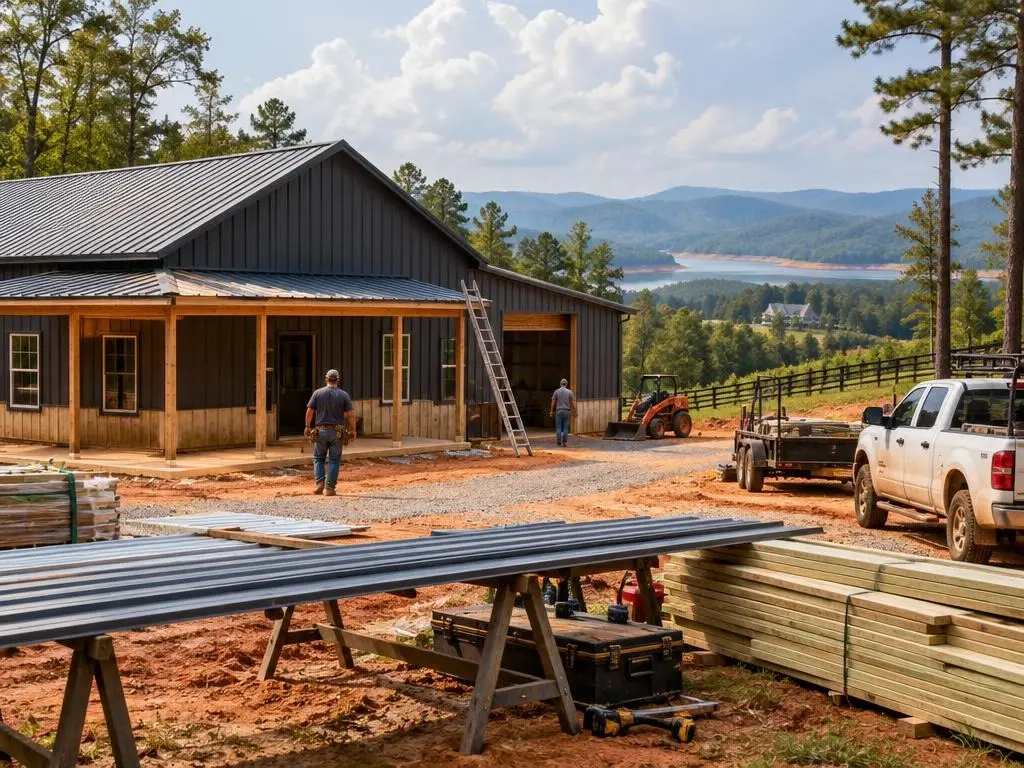
Our Services in Ball Ground, GA
Ball Ground Questions
Who issues my building permit in Ball Ground?
Inside city limits, the City of Ball Ground's Building Permitting and Inspections department. Outside them, Cherokee County.
Will we hit rock digging footings near Ball Ground?
It is possible. The area sits on gneiss and schist, and hilltop lots can be shallow to weathered rock. A soil report and test digs tell us before the foundation is final.
Can I get city water outside Ball Ground's limits?
The city's water and sewer system serves households both inside and outside city limits. We check whether a line reaches your parcel; if not, we plan for a well.
Is there flood risk in Ball Ground?
The city itself is not in a floodplain, but stream buffers still apply, and land near the Etowah River outside town should be checked against flood maps.
Free Estimates in Ball Ground, GA
Plan a barndominium on Ball Ground land.
Barndominium Builders Near Ball Ground
- Barndominium Builders in Atlanta, GA
- Barndominium Builders in Canton, GA
- Barndominium Builders in Cartersville, GA
- Barndominium Builders in Dallas, GA
- Barndominium Builders in Douglasville, GA
- Barndominium Builders in Villa Rica, GA
- Barndominium Builders in Carrollton, GA
- Barndominium Builders in Newnan, GA
- Barndominium Builders in Senoia, GA
- Barndominium Builders in Peachtree City, GA
- Barndominium Builders in Fayetteville, GA
- Barndominium Builders in Griffin, GA
- Barndominium Builders in McDonough, GA
- Barndominium Builders in Locust Grove, GA
- Barndominium Builders in Covington, GA
- Barndominium Builders in Monroe, GA
- Barndominium Builders in Loganville, GA
- Barndominium Builders in Social Circle, GA
- Barndominium Builders in Winder, GA
- Barndominium Builders in Jefferson, GA
- Barndominium Builders in Cumming, GA
- Barndominium Builders in Dawsonville, GA
- Barndominium Builders in Gainesville, GA
- Barndominium Builders in Jasper, GA
- Barndominium Builders in Buford, GA